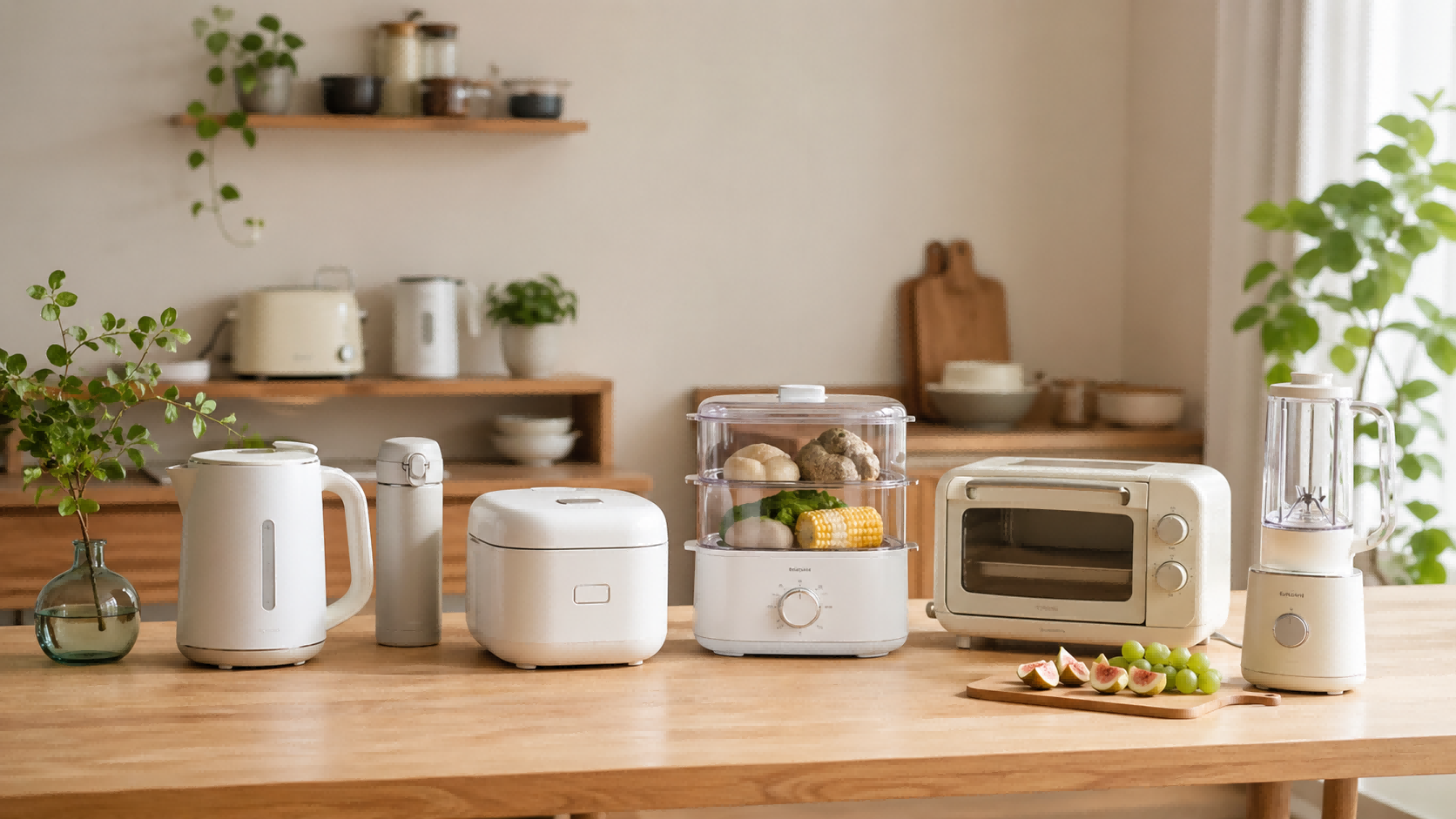
Every buyer asks it early: “What’s your MOQ?” Most get a number back — 500, 1,000, 3,000 — with no explanation of where it came from. Small appliance MOQ isn’t a sales tactic. It’s the factory’s cost structure talking. Understand the mechanics, and you negotiate like an insider.
Why factories set MOQs in the first place
A factory earns money on the hours its line runs, not on your order. Every new order forces the line to stop, change over, and restart — and that changeover costs real money before the first unit comes off the belt.
- Mold changeover. An injection-molding machine making kettle bodies needs its mold swapped, heated, and test-shot before production starts — half a shift, gone. Over 100 units it hurts; over 5,000 it disappears.
- Material batches. 304 stainless arrives in coils; plastic granules in 25 kg bags. A custom Pantone color means the compounder runs a dedicated batch — nobody fires up the line for 5 kg of pink pellets. Dye lots shift between batches, so factories buy one lot per run to keep color consistent.
- Printing plates. Your logo on a kettle isn’t free: each artwork needs a screen or pad-printing plate made, registered, and proofed — charged per design, whatever the quantity.
- Carton minimums. Printed color boxes are outsourced, and the carton supplier has its own MOQ — often 1,000–2,000 pieces. Order 300 kettles with custom boxes and someone warehouses 1,700 empty boxes.
- QC setup. First-article inspection, function-test jigs, line sampling — the same hours for 200 units or 20,000.
Below a certain quantity, setup cost per unit makes the order unprofitable — or forces a unit price you’d never accept. That quantity is the MOQ.
MOQ tiers: what changes with customization
MOQ isn’t one number per factory. It’s a ladder — the more you change, the higher you climb.
| Customization level | Typical MOQ | What drives it |
|---|---|---|
| Stock model, no changes | Negotiable, sometimes under 100 | Mostly a sales decision |
| Logo on an existing model | 100–500 | Plate making, short setup |
| Custom color, existing mold | 500–1,000 | Material batch minimums, dye-lot consistency |
| Private mold / full OEM | 1,000–3,000+ | Tooling amortization, trial runs |
Industry-typical ranges for kettles and rice cookers out of Guangdong — not a quote. Your number depends on the product, the schedule, and how much setup cost you carry in the unit price.
Custom color is the hardest MOQ to move. The rest is labor and machine time, which scale. A color batch is chemistry: the minimum lives at the material supplier, two steps upstream, and nobody there cares about your launch timeline.
Per model, per color, or per carton? Ask before you assume
“MOQ 500” means nothing until you know the unit. This is where buyers get burned.
- Per model: 500 kettles total, colors mixed. The easy case.
- Per color: 500 black and 500 white. Your 500-unit plan just became 1,000.
- Per SKU: each capacity or voltage variant restarts the count.
Ask in writing before comparing quotes. Two factories quoting “MOQ 500” can be twice as far apart in real commitment once color splits are counted.
When you can’t hit the MOQ: options that actually work
Factories hear this every week. The answers that work, in rough order of acceptance:
- Pay the setup, keep the quantity. Ask for the unit price at your quantity with setup amortized honestly. Sometimes it’s only 8–12% above the 1,000-unit price — cheaper than reshaping your launch around volume you can’t sell.
- Start with logo-only. A stock model with your logo is the lowest-setup path into production. Sell now; tool the custom version in parallel.
- Mix SKUs in one run. Many factories let two or three models or colors count toward a combined MOQ on shared tooling. Often allowed, never advertised — ask directly.
- Mix products in one container. A 20-foot container holds roughly 2,500–4,000 kettles. If one SKU can’t fill it, factories routinely load two or three products together — the freight economics without over-ordering one item.
- Accept standard packaging first. Custom printed boxes carry their own MOQ. A plain shipper with a sticker label gets you to market; upgrade the box on the reorder.
What rarely works: “just 50 units” of a fully custom product. The setup cost doesn’t shrink — the quote either looks absurd or hides the padding elsewhere.
How quantity really moves unit price
Rough math on a typical 1.7L kettle: say setup, plate making, and first-article QC cost the factory about $800 for your order. At 500 units that’s $1.60 a unit; at 2,000, $0.40. The $1.20 gap is most of the “volume discount” — not generosity, just fixed cost spreading.
Comparing unit prices across factories without fixing the quantity is meaningless. Compare at the same quantity and customization scope, and ask which setup costs are included.
Buyer checklist: 8 questions to ask before you commit
Get these in the PI before you pay a deposit. A factory that answers cleanly is usually one you can work with.
- Is the MOQ per model, per color, or per SKU?
- Does logo printing carry a separate MOQ from the product?
- Does custom packaging have its own MOQ?
- Can I mix colors or models to reach the MOQ?
- Is a trial order below MOQ possible — and how is it priced?
- Can two or three products share one container?
- What are the carton dimensions and units per carton? (Oversized cartons inflate freight per unit.)
- Which setup costs are one-time vs. per-order? (Plates and molds shouldn’t be recharged on reorders.)
FAQ
It varies — the most misunderstood part of MOQ. Get it in writing: per model, per color, or per SKU, before you compare quotes.
Often yes — two or three colors or models can combine toward one MOQ on shared tooling. Commonly allowed, rarely advertised. Ask directly.
Usually. Logo printing follows the product MOQ; printed color boxes are outsourced, and the carton supplier typically wants 1,000–2,000 pieces.
Sometimes, at a higher unit price that amortizes setup honestly — typically 8–12% above full-MOQ price for a modest shortfall. A factory that agrees to a tiny trial with no price change is hiding the cost somewhere.
Yes — standard practice. Mixed loading gets you the freight economics without over-ordering one SKU; confirm the factory handles the loading plan.
Mostly fixed setup cost spreading: on a typical kettle, setup per unit falls from $1.60 to $0.40 when quantity quadruples — that gap is the bulk of the “volume discount.”
Planning a private-label small appliance line? Request a quote — send your target quantity and customization level, and we’ll tell you straight what’s feasible.